Volkswagen has spent decades building a reputation on precision engineering and consistency. Every Golf, Tiguan, Passat, and Polo that rolls off the production line is built to exact tolerances, body panels fitted with measured gaps, paint applied through a multi-stage process, and structural joins reinforced with specific welds and adhesives.
When collision damage needs to be repaired, the repairer you choose either restores that engineering or falls short of it. Here is what to look for, and why each point carries real weight.
Genuine VW Parts Are Non-Negotiable
Aftermarket parts are produced by third-party suppliers and sold as alternatives to genuine manufacturer components. They may fit approximately, and they will often cost less, but they are not built to Volkswagen’s engineering specifications. The tolerances are different. The material grades are different. The fit is rarely exact.
For a Volkswagen smash repair, this matters at every level. A bumper bar that sits fractionally out of position affects the panel gaps on either side of it. A bonnet that does not align precisely with the guards creates an uneven shut line that is immediately visible. A structural panel replaced with a non-genuine component may not perform as designed in a subsequent impact.
Genuine OEM parts are designed by the same engineers who built the vehicle. They slot into position correctly, maintain the vehicle’s structural integrity, and preserve the manufacturer’s warranty. Any repairer who cannot confirm they use genuine VW parts for repairs should be asked why, and the answer evaluated carefully.
South City Motor Body Works uses only genuine manufacturer parts on all Volkswagen repairs, no aftermarket alternatives, no exceptions.
Following Volkswagen’s Repair Procedures
Volkswagen publishes detailed repair documentation that specifies how each model should be worked on after a collision. These are not broad guidelines – they are step-by-step technical procedures covering which panels can be straightened versus which must be replaced, where cuts can be made in structural sections, how the body shell is to be measured and realigned, and what processes must be followed in sequence.
A repairer working from general experience rather than manufacturer procedures will often make decisions based on what has worked on other vehicles in the past. For a Volkswagen, that approach creates real risk. The platform architecture of models like the Golf or Tiguan involves specific high-strength steel grades and designed crumple behaviour that requires precise handling during repair. Deviation from the documented procedure can compromise how the vehicle absorbs energy in a future collision.
When speaking with a repairer, ask directly: do you follow Volkswagen’s repair procedures? A repairer committed to the correct standard will be able to confirm this without hesitation.
Welding to Volkswagen’s Specification
Welding is one of the most technically exacting stages of any panel repair, and also one of the most consequential when done incorrectly. Volkswagen specifies the weld type, weld location, and weld sequence for each repair scenario across their model range. These specifications exist for a reason – they determine how load is transferred through the body structure, and how the vehicle behaves when it absorbs an impact.
The main weld types used in automotive body repair include MIG plug welds, which replace the factory spot welds used in production; stitch welds applied along seams; and, in some cases, continuous MIG welds for specific structural sections. Each has a defined application. Applying the wrong weld type in the wrong location – even if the result looks structurally sound to the eye – can create stress concentrations that were never part of the original design.
Beyond weld type, placement matters. Welds positioned incorrectly relative to the factory seam can miss the reinforced joining areas and bond into thinner, less suitable material. A repairer following Volkswagen’s specifications will know where every weld belongs and will not improvise.
Manufacturer Bonding Adhesives
Welding alone does not complete a structural repair on a modern Volkswagen. Structural bonding adhesive is used alongside welding throughout the body to reinforce joints, reduce vibration, seal against moisture, and contribute to the vehicle’s overall torsional rigidity. Volkswagen specifies which adhesive products are required for each application, along with preparation requirements, application volumes, and cure times.
Using a generic adhesive, or omitting the bonding stage to simplify the repair, produces a result that does not replicate the factory specification. The joint may hold under normal conditions, but it will not perform the same way under structural stress or in a collision. A repairer working to Volkswagen’s procedures will apply the correct manufacturer-specified adhesives in the correct locations, in the correct sequence with the welding process.
VW Colour Matching: Why a Spectrometer & Sprayout Card Matters
Paint colour matching is far more complex than selecting a colour from a chart. Volkswagen uses multi-stage paint systems, and the same colour code can appear with subtle variation depending on the production run, the age of the vehicle, and how the existing paint has aged under UV exposure and environmental conditions.
A professional-grade paint spectrometer measures the precise colour of your vehicle’s existing paint by analysing the light it reflects across hundreds of data points. That measurement is then used to formulate a matched paint mix that accounts for the actual current colour of your specific car – this colour is then sprayed out on a sprayout card, which is then checked against the colour on the car. Not just the factory code from the day it was built.
How the Paint Process Works
Achieving a seamless colour match is only part of what the paint process involves. Volkswagen’s factory paint system is a multi-layer application – a primer coat that prepares and protects the substrate, a base coat that establishes the colour, and a clear coat that provides depth, gloss, and UV protection. On metallic and pearl finishes, which appear across much of the VW colour range, the orientation of metallic particles or pearl pigment within the base coat layer also affects the final appearance.
A skilled painter controls the variables that determine how those particles settle, spray distance, air pressure, pass speed, and product viscosity all influence whether the metallic flake lays flat and uniform or stands at angles that catch the light differently. When those variables are not controlled correctly, the result is a panel that reads as a different shade to the ones beside it, even if the paint formula was matched precisely.
The repaired panels must then be blended into the adjacent ones. Blending involves extending the paint pass into surrounding panels and transitioning the new application so gradually that no visible edge is left. Knowing where to begin and end that blend, and how to polish the boundary back to a uniform finish, requires both technical knowledge and practical experience in automotive refinishing.
Panel Gaps: The Final Details That Reveal Everything
Panel gaps on a Volkswagen are set by the manufacturer to tight tolerances. The gap between a door and its aperture, between the bonnet and the guards, between the bumper bar and the body, all of these are measured during assembly and held within a specified range, typically within one to two millimetres of variation from one end of the gap to the other.
Restoring those gaps after a repair is one of the most time-intensive parts of the job, and one of the most revealing when it comes to assessing the quality of a repairer’s work. Panels must be trial-fitted, measured, adjusted at their mounting points or hinges, refitted, and measured again. Doors involve striker pin alignment as well as hinge position. Bonnets require guard alignment to be set before the bonnet gap can be properly assessed. Bumper bars sit against multiple reference points that all have to be correct simultaneously.
When gaps are uneven, wider at one end than the other, or inconsistent compared to the opposite side of the vehicle, it is visible to anyone who looks. It also indicates that panels are not sitting where they should be relative to the body structure, which has implications beyond appearance. A door that does not sit flush in its aperture may not seal correctly, may close with more resistance than it should, and may not perform as intended if the vehicle is involved in another collision.
Getting panel gaps right is not a finishing touch. It is a measure of whether the repair has actually been completed to the standard the vehicle was built to. A repairer who treats it as close enough is not working to Volkswagen’s specification.
The Tools Required to Do It Right
The technical standards described above cannot be met with general-purpose workshop equipment. Proper panel beating on a Volkswagen requires welding equipment capable of the correct settings for the high-strength steel grades used in modern VW body structures. Colour matching requires a professional-grade spectrometer and a paint mixing system that can formulate to the spectrometer’s output.
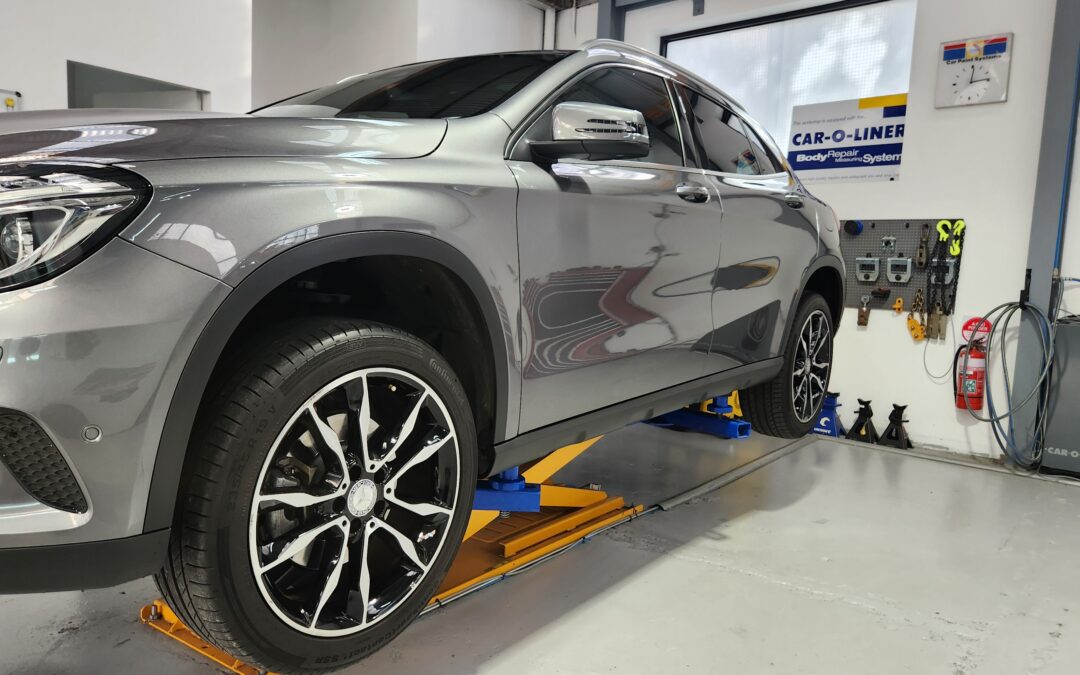
Panel alignment requires measuring equipment that can verify body shell geometry against manufacturer datum points. Refinishing requires spray booths and application equipment that can deliver the controlled environment the paint process demands.
A repairer equipped with the right tools can meet the standard. A repairer working without them cannot, regardless of how experienced their technicians are.
What to Ask Before You Commit
Before leaving your Volkswagen with any repairer, the questions worth asking are straightforward. Do you use genuine VW parts? Do you follow Volkswagen’s manufacturer repair procedures? What weld types do you use, and how do you determine placement? Do you use a spectrometer for colour matching? How do you verify panel gaps before completing the job?
The answers will tell you quickly whether the repairer understands what proper Volkswagen repair involves, or whether they are approaching it as they would any other vehicle.
At South City Motor Body Works, Volkswagen smash repairs are carried out using genuine parts, manufacturer-approved procedures, and spectrometer-matched colour formulation. Every repair is backed by a lifetime workmanship guarantee.
To book an assessment for your Volkswagen, contact South City Motor Body Works in Southbank.